
Around Rugeley Camp and Fairoak Valley
Distance: 4.75 miles | Start: Cannock Chase Visitor Centre | Grid Ref: SK 003 153
Exploring military and mining history
Download route guide (2.81 MB)
Useful information
- Difficulty: Easy
- Route terrain: Towpaths, tracks, lanes
- Start/finish: The Punch Bowl car park
- Grid ref: SK 003 153
- Postcode for SatNav: WS12 4PW
- OS map: OS Explorer 244 Cannock Chase & Chasewater
The walk
- Leave the Visitor Centre car park and turn right immediately after passing the gates (do not continue to Brindley Heath Road). Follow this road as it runs adjacent to the Visitor Centre until it intersects with Marquis Drive and cross this before turning left along the path alongside Marquis Drive.
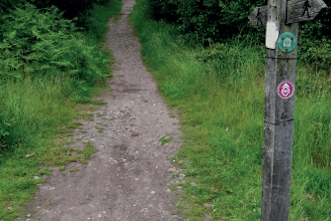
- Continue along Marquis Drive beyond the junction with Brindley Heath Road, following signs for the Heart of England Way (HOEW), until the junction with Birches Valley Road is reached (Flints Corner). The Rugeley Camp was one of two huge training camps constructed on the Chase during the Great War. Over 1,100 buildings together with roads, drainage and communication infrastructure stretched between Whitehouse, Marquis Drive and Penkridge Bank. Each camp could hold 20,000 men, along with thousands of horses.
- Carefully cross Birches Valley Road and proceed slightly right following the HOEW signs into the trees. Here the route needs close attention as it swings first right then left once, followed by right then left again. After crossing the Penkridge Bank Road it is a straight walk to the junction of a wider track in the next valley.
- At this point the route is right (away from the HOEW), and along the broad track until it intersects with the road (Rifle Range Corner). Cross the road and turn left along a narrow parallel path, passing the entrance to the Tackeroo caravan site and continuing until wrought iron gates followed by an open driveway are seen on the opposite side of the road. Here a bridleway sign pointing to the right is found beneath trees.
One hundred years on since the Chase was used for military training, heath and birch has reclaimed much of the landscape, or it is now hidden beneath conifers planted between the wars to meet the nation’s demand for timber. Practice trenches were discovered here some years ago. They are only a few feet deep, the aim being to instruct troops how to lay out trenches so that they could withstand bombardment. - The path leads down to Fairoak Lodge, after recrossing Birches Valley Road. Look out for bikes crossing at various points. Several paths come together here, but the route is forward to the right of the Lodge buildings to a metal barrier gate. The main path runs down to a cottage, but the path required is immediately left behind the barrier gate to follow a steep narrow track. This track finishes at a broader track and a left-hand turn is made here. (Option: Proceeding straight on along the wider track will return you early to Marquis Drive).
- Continue along this track and pass by Fairoak Pools. Follow the stream on the right until a further final pool is reached. Continue past this pool ignoring the wooden bridge on the right and turn right off the path when a series of stepping stones across the stream is encountered.
The Fairoak Valley has an interesting coal mining history. In 1880 it was producing 2,000 tons of coal a week and employing 400 people. - After crossing the stepping stones follow the track uphill until a bridleway marker on the left. Turn right and ascend through the trees following a path that is clearly visible as it passes through the plantation. Remain on this path and continue climbing, ignoring any paths joining from the left or right, until a T-junction with another wide path with a marker post is reached.
- Turn right and follow this track until a left turn, after a metal cross-barrier, gives access to the Visitor Centre and the car park where the walk concludes.
When the Great War ended, the camps became ghost towns. The huts were gradually sold off and transported to their new locations by horse and cart. One of the last surviving barrack huts can be seen next to the Visitor Centre. It spent 85 years of its life as a parish hall in a nearby village before being moved to its new location and fitted out as it would have looked to the raw recruits in 1916. The hut is usually open at weekends and bank holidays, and volunteers are on hand to tell its story and the history of Cannock Chase during the Great War.
Loading…
No Records Found
Sorry, no records were found. Please adjust your search criteria and try again.
Maps failed to load
Sorry, unable to load the Maps API.